|
|||||||||||||||||||||
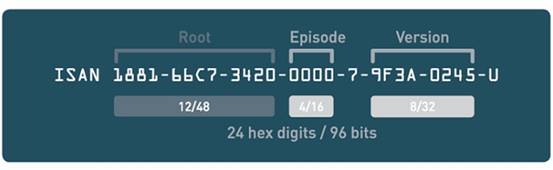
ISAN is designed to be read by humans and processed in information systems, as a 24-bit hexadecimal number or as a 96-bit binary number, for easier systems integration. The structure of an ISAN reflects many hours of careful analysis and thought by leading audio visual industry experts. It has been designed to meet the diverse needs of the entire audio visual supply chain.
ISAN Number Definition The ISAN is divided into three sections – the root, episode and version sections. The root section identifies a work throughout its existence whether it is a feature film, serial, documentary, live broadcast or any other type of work. The episode section identifies parts of a serial work sharing a common root. In the case where different versions of a work are created, these differences can be indicated by the use of the version section of the ISAN. Versions may represent differences in language, content and format. The ISAN is not a "content descriptor". It is a "dumb" number, meaning that it does not include any codes or other signifying elements. Its purpose is to identify the work with a unique number, not to provide any type of descriptive information about the work. ISAN can be affixed to any work, digital or analogue. ISAN identifies individual audio visual works, not publications, nor right holders and relates to specific descriptive metadata such as original and alternative titles, language, type, duration, cast etc. ISAN is an ISO standard, designed for all users of audio visual content from authors, creators, producers, and rights holders, to broadcasters, platform operators, content aggregators, retailers and consumers.Top 2. What is an ISAN used for? An ISAN uniquely distinguishes one audio visual work from all other audio visual works. An ISAN is a centrally registered and permanently assigned reference number. Each ISAN is a unique number permanently assigned to an audio visual work, and can identify that work across national boundaries and language barriers. The work it references is identified by a metadata set. . This metadata applies to all types of works, including versions of feature films, documentaries, television programs, videos, games, trailers, advertising, and live broadcasts. Other methods of identifying audio visual works, such as by title, can result in confusion about the specific work being referenced. For example, one title can be very similar to another. Titles also change when a work is distributed beyond its country (or countries) of origin and the title is translated into other languages As a unique identifier, the ISAN is useful in a wide range of computers ed applications, particularly those which involve databases or other content related to an audiovisual work and will be used in production and distribution systems, broadcasting applications and electronic program guides or the exchange of information about audio visual works.
Top 3. When and where can I get an ISAN? The ISAN standard was approved and published in November 2002. The ISAN International Agency that administers the system is established in Geneva, Switzerland. An ISAN can only be issued by appointed Registration Agencies (RAs) via the ISAN System following a strict set of guidelines to ensure data accuracy and system integrity. To promote worldwide usage, ISAN services are offered to the market through registration agencies. In order to obtain an ISAN, you need to: Apply for an account with ISAN Australasia as an ISAN registrant and wait for approval. As a first step visit the Create Account section of this website and download an application form. Our Business Development Manager will then contact you to discuss your needs in detail.Top 4. What is an Audiovisual work? The ISAN standard defines "audio visual work" as follows: A work consisting of a sequence of related images, with or without accompanying sound, which is intended to be made visible as a moving image through the use of devices, regardless of the medium of initial or subsequent fixation. AN ISAN can be applied to all types of audio visual work in digital form (e.g. DVD) and in analogue form (e.g. celluloid film), including motion pictures and short films, trailers, video games, television productions, individual episodes of television series, training films, commercials, broadcasts and recordings of live events (such as sports events and newscasts), video games, music video clips, composite and multimedia works if they contain a significant audiovisual component, as well as non-linear works including compilations. 5. Why does my work need an ISAN? The global digital environment has seen, and will continue to see, a rapid expansion in ways of using audio visual works – both legally and illegally. An ISAN is the most effective means of identifying your work in this environment, improving efficiencies in managing rights data, exchanging information about the work, tracking use and protecting against piracy TopThe ISAN will bring greater efficiency in tasks of the content creators, facilitators and end-users of audiovisual content. An ISAN benefits:
Other supporters of ISAN include the airline video industry organization, the World Airline Entertainment Association (WAEA) and Hollywood film studios. Broadcast standards such as ATSC, ARIB and DVB are all in various states of adopting, recommending and requiring ISAN content IDs as well as Apple iTunes, CableLabs VoD, and other broadcast industry associations. 7. Which industries will benefit? An ISAN enables commerce for several industries including feature films, digital cinema, program guide services, Internet content and gaming. The following sectors have adopted ISAN:
Specific examples include
Top 8. What are the main benefits of using ISAN? The advantages of using the ISAN system are:
The initial major users include producer or publishers for library management, optical media identification and digital cinema distribution projects. Other users include digital broadcast, cable, and many other value chain participants, including:
10. How much does an ISAN cost, including any ongoing costs? Please refer to the rate card on the downloads page 11. Will the details provided for my ISAN be made publicly available? In order to obtain an ISAN, you will need to supply the following mandatory information about the work:
12. How can I display my ISAN? What format is the artwork? Where a work is in a digital form (eg DVD), the ISAN should be embedded into the masters of the work and transferred to any copies made from those masters. The MPEG standards provide a space for the ISAN identifier in the MPEG format. Where a work is in analogue form (eg celluloid film), the ISAN should be securely affixed to the master and any archival copies. For new works, this could involve printing the ISAN on the master negative or on an interpositive. For works that already exist, the work and its ISAN should be securely linked in some form of permanent record, archive or inventory. The ISAN should also be recorded on the container of the master version whenever possible. Producer’s laboratory access letters to distributors should specify the ISAN insertion requirements for commercial prints produced from any master material. The ISAN should also be included as a data element in any systems used to manage and process information about audio visual works. It should also be included in documentation and contracts concerning the work.13. Will the details provided for my ISAN be made publicly available? The ISAN International Agency (ISAN-IA) stores the ISAN and descriptive information about each work in a central repository. There are two kinds of readers who can access this information – Public Readers and Registered Readers. Anyone seeking ISAN(s) from original titles of registered Works can query the ISAN System from the ISAN website www.isan.org free of charge as a Public Reader. A Public Reader can make two types of queries:
A Registered reader is any legal entity or individual registered as such at an ISAN Registration Agency. To become a reader, an applicant must apply to an ISAN Registration Agency first – there is not requirement in terms of audiovisual industry involvement. Registered Readers have to pay usage fees to query the system. A registered reader can make two kinds of queries:
A reader can query on-line through the website of its Registration Agency. For a mass query process, a request can be submitted to the Registration Agency who will reply in an XML format. Any XML formats will be available to registered Readers through their Registration Agency.14. How does the episode numbering work? When registering the first episode of a serial, the title for the serial must be provided. A first reference episode is created with all the descriptive information. Each time a registrant wants to add a new episode in the serial, they select the title of the serial for which all descriptive information will be initialised with the values of the most recently registered episode. This eases the registration process as only differences need to be provided; e.g. title of the episode, new actors, etc. When a new episode is registered for an ISAN, it is only checked against duplicates in the serial itself.15. Screenrights has some of my data, how can I get a list? No. The ISAN is a voluntary numbering system. There is no requirement to adopt or use an ISAN for works. However, as it is an efficient and precise industry-driven numbering system that enables the identification of audiovisual works and related versions, and is intended as a tool to facilitate business, thereby adopting an ISAN is a logical business decision. 17.How does the ISAN affect copyright registration? The ISAN is not related in any way to copyright. It is an identification number without any legal implication or meaning. It has no intrinsic value as prima facie evidence regarding the copyright status or ownership of a work. Even though the ISAN may be used by collecting societies as a tool to precisely distinguish each work in their databases, the ISAN itself does not identify rights owners. The scope of the ISAN standard clearly states: "The issuance of an ISAN shall in no way be related to any process of copyright registration, nor shall the issuance of an ISAN provide evidence of the ownership of rights in a work." 18. How does Ad-ID and ISAN work together? 19. How does Ad-ID and ISAN work together? The ISAN was developed as an International Standard under the auspices of "ISO/TC 46/SC 9":
In May 1997, ISO/TC 46 Subcommittee 9 established a Working Group (WG 1) to develop the ISAN project. The project was under the joint administration of:
Participants from several countries and international associations were members of the ISAN Working Group and active contributors to the development of the ISAN project. 20. How does Ad-ID and ISAN work together? ISAN International Agency or ISAN-IA (pronounced E-SAN-ya) is responsible for promoting ISAN worldwide, for appointing Registration Agencies, and for running and managing the ISAN system where ISANs as well as related metadata are stored in a centralized repository. ISAN is the ISO standard. ISAN-IA is the ISAN Registration Authority mandated by ISO, founded in 2003 as a Swiss Non-profit organization chartered to implement the standard worldwide. 21. How does Ad-ID and ISAN work together? An advertising work may have both an Ad-ID (Advertising Digital Identifier) and an ISAN. Please see Microsoft's white paper, which includes a table comparison between Ad-ID and ISAN.
|
|
||||||||||||||||||||
|
|||||||||||||||||||||